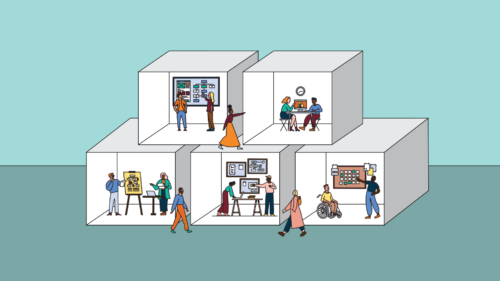
We’re Hiring: User Experience Designer (Visual)

Think Brownstone has grown in so many ways since we started, it’s hard to believe it has only been four years. Today, we have an ever-growing list of happy clients, a crew of smart and talented designers, and soon we’ll have even more Think Space. There’s a lot of work to do, and it’s time to add another Brownstoner to the ranks.

This time around we’re looking for someone with a special combination of skills that are near and dear to my heart. As an experience design consultancy, 80% of the work we do every day involves helping people think through solutions to problems, streamline user workflows, and sketch easy-to-use interfaces – these are essential Think Brownstone skills. Then there’s the other 20%: Visual Design. Making It Beautiful. “Bringing It Home.” My training in graphic design taught me about this important step in the design process – and in today’s highly competitive market, smart companies know that making their stuff really beautiful is simply not optional. And so, we’re in the process of growing our team of visual designers.

Brownstoners

Some Of The Crew. And You?

Here’s the official job description:

Position: User Experience Designer (Visual)

Responsibilities:

  • Create beautiful user interface and visual designs for web, mobile, and touchscreen applications
  • Come up with solutions to clients’ problems via design and usability recommendations
  • Work collaboratively as part of a creative team that includes both clients and internal colleagues
  • Build and maintain positive relationships with clients
  • Facilitate creative brainstorming sessions with clients and internal project teams
  • Stay up-to-date on the current and best UI and visual design practices and trends; stay up-to-date on current web technologies and innovations

Requirements:

  • Bachelors degree or equivalent
  • Minimum 2 years of professional interaction, user interface, and visual design experience – with an online portfolio to showcase this work
  • Fantastic presentation, verbal and writing skills
  • Advanced skill in Adobe Photoshop and Illustrator or equivalents
  • Solid understanding of how front-end code (HTML, CSS, Javascript, AJAX, etc) is employed to translate visual designs into interactive digital interfaces

Bonus Points:

  • Skill in Web Standards compliant HTML and CSS development
  • Experience designing interfaces for iOS applications (iPhone, iPad)
  • Obsessive attention to detail
  • Project management experience or willingness to take on some project management responsibilities

Perks:

  • Excellent benefits: health, life, disability, IRA, PTO, yoga
  • Competitive salary
  • Awesome creative workspace in downtown Conshohocken: walking distance to great local restaurants, easy access to Philadelphia via regional rail

Apply: Take a look around the rest of our blog and you’ll learn that we’re a diverse group of designers who love our jobs and have a pretty darn good time here at work. If you’re a talented Experience Designer with a focus on the visual/aesthetic and a stunning portfolio that highlights your interactive experience, let’s talk. Send an email with a cover letter, resume and link to your online portfolio to work@thinkbrownstone.com with the subject line, “I Think I’m a Brownstoner”. We look forward to meeting you.

Facebook: What Does “Most Recent” Mean To You?

Does Facebook’s “Most Recent” news feed deliver results based on user behavior? If so, this is probably one of the best kept secrets by the Facebook team. Although I can’t find specific research on the topic, I can lend you my insight from some haphazard research as a user. Through consistent analysis of my personal feed I’ve come to the conclusion that, yes, the “Most Recent” feed includes behavioral modifications in its algorithm.

I’ll walk you through a recent example. “Janice” is a friend of mine that I haven’t contacted, whose profile I haven’t viewed, and whom I haven’t seen tagged in any photos. She happens to send me a message through Facebook: “Hey, Nick. Long time, we should catch up, I just finished my latest photography portfolio and think you’d really dig it.”

It’s nice to hear from Janice – we haven’t spoken since high school. After responding, I visit her profile, check out her current status, and casually peruse her Facebook life. From there, I see that another old friend, “Steven”, recently posted a status update that he’s sick of the weather. Janice rebutted, noting that the rain is a great break from the heat. Her interaction with Steven is the reason I’m able to view his update on Janice’s wall.

I click into Steven’s profile and similarly do some scrolling and reminiscing. Whilst traveling down memory lane and satisfying an internal dialogue (what’s he been up to? where’s she living these days? etc.) my digital actions of clicking, responding, and viewing have created a new and unique trail of information from Janice to Me to Janice to Steven.

QUESTION: Will this update from a friend appear in my "Most Recent"? Scroll down to find out!

This is where I believe Facebook’s algorithm begins to track behavior based on actions to populate a different set of results in my ‘Most Recent’ news feed. You see, the next day I get to work and the first thing I do is check Facebook (who doesn’t?) – and sitting there in my ‘Most Recent’ news feed are various updates and comments from Facebook friends including Janice and Steven.

It struck me as relevant, but piqued my curiosity as I hadn’t recalled ever seeing Steven’s prior update on the weather in my feed. I clicked into Steven’s profile and saw he had a few recent updates in the past couple of days. Going back through my ‘Most Recent’ history (which only goes back about 3 or 4 days FYI) proved that Steven’s earlier updates had never appeared in my feed.

It took these digital actions between my account and Steven’s for him to appear in my news feed – and I’m assuming I also appeared in his ‘Most Recent’ feed. But did I, if I only viewed his information but didn’t interact with him directly?

Either way…there’s obviously more going on there than simply “Most Recent”. Is this good? Is this bad? I can’t answer that question for you…but I’ve always assumed it’d simply be the most recent activity from everyone in my Friends list, and that might once in a while spark interactions with folks I very rarely see or talk to. But if Janice hadn’t sent me that message, it’s unlikely I would have connected with Steve otherwise (or seen his grippingly important update on the weather, natch). What I would like to know is how exactly the Facebook team is determining who is appears in my ‘Most Recent’ news feed?

ANSWER: Nope!

The two pictures I posted are an example from my account. In this example, It proves that not all updates are posted to your ‘Most Recent’ feed. As in this case, a friend posted a comment in reference to Battlestar Galactica on Monday at 9:48, but in my ‘Most Recent’ feed, that comment never appeared.

Critical Thinking, Problem Solving, and Papa

Inspired by Russ’ post a few months ago about his dad, I’ve been thinking about the things I learned from my father.  This Father’s Day, I woke up early to run to the bakery and pick up some goodies for brunch, and this blog post started to form. I would never have time to document everything Papa has taught me through life or how I value them today, but two important lessons are below. The first is one of the secrets to a happy life and the second lives at the core of the design process.

Lesson #1: Leave No Baguette Untorn

Between 1974 and the early 80′s, we had a common Saturday morning routine. Around 7AM, Papa would stick his head in the bedroom my brother and I shared and whisper very loudly, “Paul, Philip, are you awake yet?” Although this sounded like a question, it actually meant, “Get up, get dressed, half the day has gone and there are things to do.” By 7:30, we were standing at the counter of the only French bakery in suburban Philadelphia, buying the weekend’s supply of baguettes and croissants. As a treat, we’d order 3 pain-au-chocolats. You may know them better as chocolate croissants.

Leave No Baguette Untorn

Leave No Baguette Untorn

Back in the car, the pain-au-chocolats would disappear in a shower of pastry flakes. Once they were done, we would wait for my father to reach into the bag and tear off the end of one of the warm baguettes before we followed suit. Baguette + Car = Snack is a rule I follow to this day. My mother, my loving wife, and my brothers- and sisters-in-law have all learned to live with the fact that a Charron is incapable of delivering a stick of bread unharmed.

It is important to understand that Papa emigrated from France to the US in his late teens. Here, he went to college, joined the army, became a citizen, married Mom and they raised a family. His patriotism, like that of many who choose to be an American, runs deeper than many natural born Americans. I am grateful, however, that he never shed the culinary side of his upbringing. A true Frenchman knows that good bread is one of the secrets to happiness. After all, you never know when you’ll get hit by a bus…you may as well be eating good bread when it happens.

Lesson #2: Critical Thinking and Problem Solving

After the bakery, we would often head to the appliance repair shop. Here we’d pick up a belt, motor, thermostat, or switch for Papa’s nemesis: the 1973 GE electric dryer.

1973 GE Electric Dryer

It still lives: the bain of Papa's existence. Photo: courtesy Papa and his new Blackberry

Papa is an electrical engineer. More specifically, he worked as an aerospace engineer. Due to the top-secret nature of most of his work, I’ll never know the specifics of his job. I do know that he knew astronauts and he designed things that orbit the earth. Despite these accomplishments, he could never permanently repair that damn dryer.

So, over the course of a decade, I spent many weekends in the laundry room absorbing Papa’s critical thinking and problem solving skills. The repetition made it stick. Mr. Miagi had “Wax on, wax off.” Papa had, “Hold the flashlight.” Here’s how it worked:

Step 1 – Identification and Initial Diagnosis

Mom would say, “The dryer doesn’t work.” Papa would begin to diagnose the problem with a few questions: What isn’t happening? Does it still get hot? Is it spinning? Does it make a sound? As frustrating as this must have been for Mom, he started from the beginning. No question was too stupid. Once he had a general idea of the condition, we’d head to the laundry room to work on Step 2.

Step 2 – Analysis and Verification

We would pull the dryer away from the wall, disconnect the vent, unplug the beast, remove the service panel, test the suspect component with a voltmeter, remove the faulty part, and get a good night’s sleep. Even though you had a good idea for what the problem was – you had a bevy of tools to make sure you were fixing the right thing. At 8 years old, Papa was walking me through circuit diagrams. By 10, they kind of made sense. From 23 to 40, I have been drawing flowcharts on whiteboards to help clients improve their own processes.

Step 3 – Repair

After picking up the much-needed weekend necessities of bread and cheese, we’d buy the replacement parts and head home to make the repair. Installation is often the quickest part of the process.

Step 4 – Testing

After installation, we’d pull out the voltmeter to see if the circuit was behaving correctly. Then we’d partially reassemble the drier. Before closing up and reconnecting the vent  - we would plug it in to make sure it worked. If something still isn’t working – head back to Step 1. Testing is an incremental process. If you test at the very end and discover the problem persists or that you caused a new problem, it’s a lot more work to re-dis-assemble the thing. Test in stages and you waste less time, energy and frustration.

Design Is Problem Solving

This process and the rules around it are no different than what I do every day at work. Design is problem solving. Regardless of whether you’re fixing a dryer or helping a client solve a business challenge, the core of the process is universal. I know that the steps that put satellites in space and kept a dryer alive for almost forty years are going to help our clients.

My folks are moving soon and Papa promised that the dryer isn’t going with them. That’s OK. The dryer has paid its dues and the ol’ man deserves to sleep in on Saturdays.

The PROTECT IP Act: What You Need to Know

If you’re a regular reader, you know that the Think Blog is generally where we expound on ideas that are impacting our lives as Experience Designers. For this post, though, I’d like to take a step back and talk about something that is going to impact your life. End of sentence. No qualifier. This will impact your life.

Unless you’re an über geek of the political or technical variety, you probably haven’t heard of the PROTECT IP Act currently making it’s way through Congress (or its prior, defeated, incarnation COICA). The intent of this bill is to give the US government (and private parties) new powers to halt online infringements of intellectual property, especially in regards to domains registered outside the US. No problems so far, right?

The issue is how these new powers are described, enacted, and enforced.

"Just what do you think you're doing, Brad?"

Quickly, let’s talk about why this applies only to domains registered outside the US. Simply, there is ample legislation protecting IP from infringements from within our borders. Between the Digital Millennium Copyright Act of 1998 and the Department of Homeland Security’s recent seizure of “offending” domains (an act of questionable legality, some would say), there are plenty of tools for IP holders to prosecute alleged violations of their rights within the US. That same action becomes difficult when there is no US registrant of the domain in question.

The solution posed by PROTECT IP (and previously COICA) is to wipe those allegedly offending domain names from the collective indexes of any “domain name system server” (we don’t need to get into it here, but the vague nature of this definition is troubling by itself), thus rendering the site effectively non-existent…unless you happen to know its IP address…or they change domain names…or use non-filtered DNS servers…etc. As many have shown, this would encourage a huge fracturing of the DNS system which essentially ensures that when I type “www.thinkbrownstone.com”, my browser knows at what 10-digit IP address TBI’s website lives. Needless to say, this approach has some faults.

To better illustrate, here’s an example:

I’m a law-abiding Swede with a fantastic idea for a new website that will allow people to post images, videos, and other kinds of media celebrating the culinary masterpiece that is the pancake (also accepted: crêpes, pfannkuchen, pannenkoeken, palacinka, and others). We’ll call it Pancakr. Let’s assume that my site begins to take off and I manage to get VC funding, despite the lawyers’ newfound trepidation of running afoul of PROTECT IP. Pancakr goes viral and everyone is posting pics of their latest quick-bread conquest. Unfortunately, many of the pics from the US feature PancakePuss, a trademarked character of the ISLOP restaurant chain. I should also mention that because Pancakr has gone so insanely viral, sites are popping up all over the Web with Pancakr related (and unlicensed) merch. PancakePuss is particularly popular, especially on t-shirts.

ISLOP is unhappy to be missing out on the royalties, but because all this activity is being done by non-US actors, the PROTECT IP Act is their only viable option. The Justice Department orders all domain name servers, ISPs, search engines, and social networks to stop redirecting to a host of sites accused of violating ISLOP’s IP. Pancakr is on that list, despite the fact that its biggest “crime” was providing the ability for people to link to their favorite pancake photos. Two years pass as we litigate our way through the judicial system, finally winning reinstatement in the DNS catalogue. Not that it matters at this point. Honestly, the investors would have been smart to drop the case and just move on to the next big thing. Two months, two years, two hundred years…they’re all the same when you’re vying for a sliver of the 21st Century attention-span. Oh, and those PancakePuss t-shirts? They’re still selling like hotcakes all over the web.

OK…a bit silly…greatly over-simplified…but you get the point. Wide nets, presumption of guilt, half-baked solutions built on tenuous technical knowledge, and a blatant disregard for free speech make for sloppy, ineffective, and downright dangerous law.

To clarify even further, here’s why this is going to impact you (assuming you use the Internet or participate in 21st Century Society).

  • This is a Ready, Fire, Aim approach. Domains would be guilty until proven innocent.
  • It makes linking to material that may be copyrighted (see point #1 above) cause enough for shuttering. Do you like YouTube? eBay? Flickr? Imagine them getting funding in their nascent years under this Act. Goodbye innovation.
  • The Internet, to date, has been revolutionary in that it is truly world-wide and without borders. PROTECT IP would end this by creating a “US-approved” subset of the Internet. One can easily see how this Balkanization would quickly spread and the damage it would cause.
  • As a society, we value creativity and try to protect it. However misdirected PROTECT IP is, that is the right and good intent that I believe Senator Leahy is trying to uphold with his bill. There are other societies who value conformity and obedience. Where is our moral credibility to denounce their Internet restrictions when we do the same?

You could (and perhaps should, given it’s potential impact) spend hours reading up on PROTECT IP. I similarly could spend many more hours writing about it. Let’s make a deal instead. If you still have questions, read the links I’ve included in this post. If you  want more, just search “PROTECT IP”. Once you’re satisfied, contact your Representative and Senator and tell them what you think (pro or con). Ideally, write them a real paper letter or give them a call (email is still kind of a second-class citizen in terms of impact). If the Internet has taught us anything, it’s that a lot of people taking very small actions can have a huge impact. Let’s get all Groupon up on this thing!

I’m sending letters to my Congressmen today. Won’t you?
(seriously…do it…they will hear you)

Find your Representative: http://www.house.gov/representatives/

Find your Senator: http://www.senate.gov/general/contact_information/senators_cfm.cfm

P.S. Big thanks to Leo Laporte and his TWiT podcast for turning me onto this issue!

A High School Internship at Think Brownstone

When I was little, my dad worked at a consulting firm.  He was in a project management role and worked with designers, business analysts, and information architects.  It was my first exposure to this area of the working world and I realized that it could be an area of interest to me.

Flash forward 8 years – I’m a senior in high school and looking for somewhere to intern for my senior project.  I was brainstorming ideas with my dad and he suggested his old friends that were now working at Think Brownstone.  Right away I thought it was a perfect idea.  They would be a fun group of people to spend time with and I’d always been interested in the problem solving and usability part of business.

Presenting To The Think Brownstone Crew

So I started my internship. I sat in on all types of different meetings – everything from insurance companies to non-profit organizations.  Most of the time the meetings were long and pretty confusing, but it helped me learn a lot more about what Think Brownstone is all about.  I learned that they are basically problem solvers, and they apply the design process to almost any business problem.

This opportunity has taught me a great deal about this really interesting type of work and I want to learn more.  Overall, it was a really good experience!


DMI “Value Of Design” Conference Recap

Brian, Carl & I headed to Amsterdam last week to attend “The Value Of Design” – a conference held by the Design Management Institute (DMI). Why travel to Amsterdam for this? Well, there were a number of good reasons:

  1. We’re extremely interested in the topic, as we’re continuously looking for effective ways to explain the value of design to our potential clients (and the world, for that matter). A conference dedicated to full exploration of the subject, with built-in peer collaboration/discussion sessions, was right up our alley.
  2. We’re interested in making connections in Europe and worldwide, to continuously grow our global insight and also to plan for future partnerships or office locations. A full roster of international design professionals (speakers and attendees) was a huge draw.
  3. Dude, it’s Amsterdam. Have you had a fresh Heineken and a stroopwafel?

So, in keeping with tradition, I’ll provide our high-level impression of the conference and Brian will provide interactive sketchnotes for some of our favorite sessions. Be sure to hover over each sketchnote image for links to lots of great information and resources.

dmi-amsterdam-sketchnote

Brian's interactive sketchnotes. Click image to see 'em all.

Overall, we were really impressed and felt that we got a lot of value for the investment. As we debriefed, some telling things rose to the top. For instance, there was a refreshingly low hipster quotient, with absolutely no talk of ninjas, superheroes, rockstars, or zombies. Not that those things aren’t fun…just, tired. There were plenty of laughs besides.

The venue (the Felix Meritis) was a brilliant choice, and infinitely better than a conference room at a hotel complex. There were a few logistical problems due to the uniqueness of the space, but the organizers handled them very well and we’ll take that any day as the potential price to pay for two days at such a distinctive location. The food was great, the pacing felt right, and there was ample time for networking, breaks, and reflection.

Perhaps most importantly though, we were amazed and heartened by the speakers not only sticking around for the rest of the day after they were finished, but for the rest of the conference. They participated in the breakouts and exercises, asked questions from the audience, ate meals and attended happy hours with the rest of us as equals. You might think this shouldn’t be an exceptional case. But it was. It made a big difference.

dragons

Marty Neumeier at DMI Amsterdam 2011

So what of the sessions themselves? As with all conferences, some hit harder than others – and that’s par for the course. However, there was healthy skepticism openly and professionally offered where warranted (as opposed to only passive aggressive Twitter-snark), rich discussions as a result, and on the whole, very strong content. It was interesting to have so many speakers all orbiting around a central issue – at times it made us long for something “off-topic”, but in the end it was one heck of a concentrated punch. We’re DMI converts, and grateful for all of our new friends and connections worldwide – that’s the way to do it!

CDC’s Zombie Apocalypse Goes Viral

It’s been a busy week at Think Brownstone and I’ve been trying to post something on the Think Blog. Although I have a backlog of topics to get to, every time I put hands to keyboard I had a bout of writer’s block…  until Brad mentioned the odd juxtaposition of the upcoming Rapture and the CDC’s blog post on preparing for a Zombie Apocalypse May 16th.

Since the original publication on the 16th, the CDC’s article has been going viral at a slow, lurching pace. It finally landed on the front page of CNN at 2:09 May 19th. Coincidentally, most scientists agree that’s about the same amount of time it would take the Solanum Virus to overtake the US Eastern Seaboard.

Braaaaaiiiinnnnsssstorming

I’m confident that the CDC’s blog post and the Rapture events are purely coincidental, but I wanted to take a moment to commend the CDC’s courage in publishing this story. The article is actually a well thought-out piece that uses the zombie apocalypse as a metaphor for emergency preparedness. As it turns out, most of what you need to do to prepare for a zombie attack is similar to what you would be doing if there were a hurricane or tornado warning.

If I had to guess how this article was approved for publication, I’d imagine some government stuffed shirt raised concern that this serious topic deserves a serious treatment. Turns out, the government has tried that approach before with mixed results. One or two wise folks in the room pointed out that the goal of the article was to raise awareness. What better way to raise awareness than to get attention with a tongue-in-cheek title and introduction?

Perhaps this mini-campaign came out of a technique we use at Think Brownstone when a team is having trouble generating new ideas: Reverse Brainstorming. In a reverse braaaiiinnnnssss storming session, the participants come up with ideas that would prevent them from achieving a goal or that would cause their problem state. Once you have a good list, brainstorm ways to prevent those things from happening. Poof – you now have a list of things to help achieve your original goal. It’s the reverse-reverse psychology of brainstorming methods and, among other things, it can help get you out of a rut.

The CDC only gets one chance to do something like this before it starts to look schlocky, and I think they aced it. Now, if you’ll excuse me, I have to buy some duct tape, canned beans, a baseball bat, and some extra shotgun shells (’cause you know, rule #2 and all).

Google Analytics: This Beta Needs Better Data Visualization

Google Analytics recently launched a new interface (in beta, of course). Sadly, for a tool intended to help its users understand and process data, they have done very little to improve the data visualization tools built-in to the application.

Let’s pick on the Visitor Loyalty graph, which has always bothered me. It looked like this:

Google Analytics Loyalty Chart

Google's Old View of Loyal Users

And now, the new-and-”improved” graph looks like this:

New Google Analytics Loyalty Chart

Google's New View of User Loyalty

The only thing Google improved here is changing the name from Visitor Loyalty to Frequency & Recency. The concept of “loyalty” is relative to your users, their goals, and the context of their usage, so frequency may not even be a good indicator of loyalty. For example, a loyal Google user may visit google.com more frequently than a loyal Amazon user visits amazon.com. However, a loyal Google user probably views less pages per visit than a loyal Amazon user. That does not mean that either user is less dedicated to the site, they just fulfill their needs in different ways.

So, the name change is good, but what has bothered me most about the old graph still hasn’t been fixed. My concern is that it’s virtually useless to anyone who spends time with it, and misleading to anyone who only glances at it.

Apples Meet Oranges

If you look down the left side of the graph, you’ll notice that the scale is all wonky. It goes from 8 visitors to the range 9-14. This weird incrementing creates what appears to be a bump in the data around 9-14, when it is probably a smooth curve if you map it out correctly. If that’s not confusing enough, each range is different. Another way to express the increments they are laying out would be: 1, 2, 3, 4, 5, 6, 7, 8, next 5, next 10, next 25, next 50, next 100, everything else. So, while the bump at 201+ may cause an initial wave of euphoria, you soon realize that the 159 visits in that bump are probably spread evenly between 201 and 360.

(Before you ask, I’ve checked across all of the high-volume and low-volume sites we monitor for our clients. The wonkification of the scale doesn’t change.)

I get what they are trying to do. Loyal users will show up in clusters around one of these increments, but when the increments continue to adjust along the span of data, it’s impossible to compare one chunk to the next. What seems to be bumps are probably nothing, but there’s no way to be sure. There cannot be a generic benchmark for frequency that applies to all sites. Trying to genericize a graph using arbitrary increments is a disservice to the data and only misleads your users.

So, how would YOU do it, Phil?

Well… the first thing I would do is make it a line graph to generate a smooth curve with a consistent scale from 0 to X, where X is the most number of visits recorded. That’s easy to do and Google Analytics uses line graphs elsewhere, so we know they have the graphing capability. It would look kinda like this:

A Useful Visitor Frequency Chart

A Useful Visitor Frequency Chart

OK, Phil, why is THIS better?

It’s better for me, but maybe not for everyone. It depends on what you need to do with the graph.

I was once asked by a client to briefly explain how I find odd things in their analytic data before anyone else. There are many different reasons to be looking at analytics reports. I play a troubleshooting role on that team, so my answer was simple: “I follow the trend line and look for aberrations. If I find one, I dig into the data to find the root cause. Then I call you.” The chart above wouldn’t set off any alarms, but the chart below would cause me to dig:

Oooh, piece of candy!

Oooh, Piece of Candy!

That peak would make anyone wonder what’s going on, but with the bar charts that Google uses, that peak would end up buried inside one of the wonky ranges.

But that’s only how I would use it for a role I play on a specific team for a site that has unique needs. That’s the weakness of the Google Analytics interface that I was hoping they would fix. I want to be able to customize their charts like I can in Excel. Sadly, the data visualization tools they offer in the new interface aren’t enough. Even more sadly, when I export the data from the wonky chart, it retains the bizarro scale. So even if I wanted to use my own charting software, the data is garbage. To quote my film editing professor, “garbage in, garbage out.”

What Would Tufte Do? (WWTD)

When I encounter poorly communicated data, I ask myself, “What would Tufte Do?” Edward Tufte has authored several books on data visualization.  While his work has sparked much debate, I believe he would have a lot to say about the use of bar charts for something like Loyalty or Engagement.

You see, even though the charts presented by Google Analytics are missing the chartjunk Tufte has railed against, they rarely communicate data in an appropriate manner. A bar graph is absolutely the wrong tool to use to analyze this set of information. To select the appropriate mapping of this data, you first have to ask yourself, “What is the user going to do with this data?”

For something like engagement (which Visitor Frequency hints at), you may want to know:

  • What are the behaviors of an engaged user?
  • Are we losing, gaining, or keeping a consistent level of engaged users?

Both of these would require completely different visualizations of data, but neither is served by the out-of-the-box graphs presented by Google. My gripe about the out-of-the-box graphs in Google Analytics is that I often can’t figure out what they are trying to tell me, and they don’t let me customize the graphs to meet my needs.

We are entering a period where strong data visualization is getting a lot of attention. It’s more than making pretty pictures, it’s making images that provide value and answer questions. Google Analytics is a valuable tool for an unbeatable price, but when a new version is launched and the greatest value you’ve added is a UI facelift, you’re kind of missing the mark.

Design Thinking: Don’t Call It A Comeback

Like so many other things in the blogosphere, Design Thinking is apparently dead. That is, if you agree with Bruce Nussbaum, the once eloquent champion of Design Thinking who recently declared that it was a failed experiment and that it’s time to move on. Apparently, he’s not alone. A growing number of critics are joining the chorus – some have gone so far as to say that extolling the virtues of design thinking is at best misguided and at worst, likely to inflict dangerous harm.

As the argument goes, Design Thinking was envisioned to inject creativity into the hyper-analytical, profit-driven processes that hamper organizational change and innovation. As it evolved over the last decade, it was commoditized to appeal to business culture and eventually transformed into a linear, methodical, risk-averse Process (with a capital P). It’s suggested that this Process stifles, not cultivates, the experimental, precarious, and often disorderly activities that fuel innovation.

Available at your local tattoo shop. You might want to get it only as a stick-on.

Others think that business never bought into the message. Helen Walters notes that there was never really a consensus on the definition of Design Thinking or agreement as to how it should be implemented. Purported successes were either elevated as the unrivaled accomplishments of the elite few who “got it” or degraded as merely incremental changes that would never amount to widespread organizational transformation.

Still others argue that Design Thinking was doomed from the start. It will never produce the results we were hoping for because design considerations will always be an afterthought, long after strategic decisions about a product or service have been established. Business is driven by numbers and expediency, not creative chaos. Therefore, designers should just be resigned to their fate as “aesthetic window dressers.”

Ironically, Nussbuam’s post included a video in which he asked Tim Brown from IDEO if, within this period of great turmoil, design should be considered a social movement. Brown replied that the concept of design as a social movement is not new but what may make it so is the combination of Design Thinking plus social networking sites, collaborative environments and all of the other things that are allowing so many more people to create and/or influence design outcomes. It’s through what he calls “the democratization of design,” that design has the potential to solve major social issues.

On the one hand, Design Thinking has no sustainable value but on the other hand it has the potential to transform our world? I don’t get it. It’s not time to move on. It’s time to refocus. The best place to start is to establish a consensus on the guiding principles of Design Thinking… a credo of sorts. Here are some initial thoughts to jumpstart the conversation:

Design Thinking Thrives On Passion For Purpose

Design Thinking is inspired by an unwavering commitment to improve the human experience. We believe that meeting this challenge improves quality of life for all of us, and we’re committed to doing it one company, one process, and one outcome at a time. We help our clients envision and enact solutions within the context of what’s important to both the users and business. Organizational politics, unrealistic deadlines and arbitrary constraints may deter our progress but we’re committed to fighting the good fight to rid the world of frustrating experiences from the most endemic and systemic to the most mundane and minute. We’re okay with incremental change as long as it’s constant.

Design Thinkers Work With Their Clients, Not For Them

We share a deep appreciation for, and commitment to, a holistic view of design – infused with experiential wisdom and a process (yes, a process, but with a small “p” because it’s open and flexible) that enables us to tackle complex business problems, with our clients. We don’t say to our clients, “okay…now we’re going to go off for a few weeks, do some design thinking, and come back with an idea that’ll make you more innovative.” We simply guide them to think in a different way – to understand the benefits of an iterative and interactive process. We work collectively to achieve a common understanding of the problem and opportunities before us, to observe and learn from those who will be experiencing our outcomes, and ride the ebb and flow of the creative process recognizing that the true innovation is never constrained by the status quo.

Design Thinking is Contextual

Design Thinking is an inclusive process that leverages the collective knowledge and experiences of those who are most impacted by its outcomes, but it must also address the overarching needs of the business. We have to come to terms with the fact that our clients are not going to pursue novel solutions without the promise that they will contribute to the bottom line. If we want to ensure that design considerations are at the forefront of strategic discussions, we have to be diligent about framing design outcomes within the context of market opportunity. In a sense we have to be “a creative group with business minds.” To this end, we must commit to an ongoing dialogue by sharing our stories of success and failure and learning from each other’s experiences rather than simply espousing the idea that only a select few can actually get it right.


What do you think? If you believe that it’s way too early to declare that Design Thinking is a failed experiment, what inspires you to stay focused?

Taking The Design Conversation Beyond Designers

My dad was a teacher (industrial arts, performing arts, special education), a general contractor, a motorcycle enthusiast, a trumpet player, a furniture maker, a lethal racquetball player, a cigar aficionado, and a whole host of other things. On paper that seems like the resume of a pretty well rounded individual – and he certainly was. But what is very interesting in retrospect is how he wasn’t any of these things in isolation. His knowledge of all of these little aspects of life informed decisions he made elsewhere, resulting in novel approaches to challenges that often suffered from a tradition of “having always been done that way.”

This broad and general interest in, well…everything…and his ability to distill concepts and apply them elsewhere, was one of the reasons why he was very often successful when diving deeper for projects within his “professions.” I believe that one of the best things you can be as a designer is open-minded, wide-eyed, and eager to learn how and why people do things they do – whether it’s why carpenters use those seemingly antiquated flat pencils (1), why the sommelier hands you the cork after opening a bottle of wine (2), or why a semicolon, dash, and closed parenthesis has become widely recognized a winking smiley face (3).

ANSWER KEY!

  1. Because they don’t roll away – not to mention that they’re more durable for throwing them in with a bunch of other tools, have better grip, can draw thin or thick lines depending on how they’re rotated, and are tough enough to mark up concrete and stone.
  2. Because feeling a cork to determine how cool, wet, dry, hard or soft it is can tell you a lot about whether the wine has been properly stored – it’s not to smell it.
  3. Because of the “Law of Prägnanz” – the tendency of humans to interpret ambiguous images as simple and complete versus complex and incomplete.

Sometimes the various design circles we travel in can feel pretty insular. We tend to see the same folks showing up repeatedly as speakers and attendees at conferences, tend to all react to and discuss the next big idea (or internet meme) as a community, and tend to put our thoughts and ideas out there knowing that the people swimming in the lanes closest to us are those most likely to read and comment on them.

There’s nothing inherently wrong with that, and it’s great to have a community of colleagues to kick things around with…but perhaps obviously, the best designs often come from being inspired by and interacting with folks who don’t populate our beaten paths (like the inspiration sparked by the whole TED model, for instance).

As designers at Think Brownstone, it’s a measure of success for us to have our ideas and conversations ripple out beyond our peers. We’re starting to see evidence of that as we’ve recently had comments on the Think Blog from academics, musicians, consumers, and others – as a design community, this kind of interaction will only make us stronger and more creative.

I’ll close with one of those pearls of wisdom from my dad that was delivered in a typically off-handed and matter-of-fact way, but that I’ve never forgotten. One hot summer day when I was a kid, as the garbage truck came lumbering down the street, my dad dropped what he was doing and said “hey, come help me grab some beers out of the fridge” (yes, you read that right – beers). When the truck pulled up, my dad handed a generous amount of cans to the genuinely surprised and grateful men. As it rolled away I asked him why he did that…

“Everyone you meet in life, whether it’s the guy picking up your garbage, the guy signing your paycheck, or the guy begging you for change, knows how to do a thousand things you don’t know how to do. Aside from just being nice to people because it’s a good way to be, you can learn a shitload from them.” – Bill Starke